
Relays
Relay
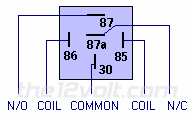
87 (Yellow) Power Positive (+)
86 (Black) Ignition Switch (+)
30 (Blue Wire) Out put to Fan (+)
85 (White) Ground from Temperature Sensor (-)
87A Is not being used in our application.
Fans
Each fan will get its own relay to eliminate over heating. From my personal experience, one relay per fan. The relays would be wired together with the exception of Number 30 (Blue Wire). Each blue wire from the relays should connect to the fan and other of wire from the fan will be ground (get negative from the frame).
When the coil of the relay is at rest (not energized), the common terminal (30) and the normally closed terminal (87a) have continuity. When the coil is energized, the common terminal (30) and the normally open terminal (87) have continuity.
The diagram above center shows the relay at rest, with the coil not energized. The diagram above right shows the relay with the coil energized. As you can see the coil is an electromagnet that causes the arm that is always connected to the common (30) to pivot when energized whereby contact is broken from the normally closed terminal (87a) and made with the normally open terminal (87).
When energizing the coil of a relay, polarity of the coil does not matter unless there is a diode across the coil. If a diode is not present, you may attach positive voltage to either terminal of the coil and negative voltage to the other, otherwise you must connect positive to the side of the coil that the cathode side (side with stripe) of the diode is connected and negative to side of the coil that the anode side of the diode is connected.
Diodes are most often used across the coil to provide a path for current when the current path to the relay is interrupted (i.e. switched off, coil no longer energized). This allows the coil field to collapse without the voltage spike that would otherwise be generated. The diode protects switch or relay contacts and other circuits that may be sensitive to voltage spikes.
Why do I want to use a relay and do I really need to? Anytime you want to switch a device which draws more current than is provided by an output of a switch or component you’ll need to use a relay. The coil of an SPDT relay that we most commonly use draws very little current (less than 200 milliamps) and the amount of current that you can pass through a relay’s common, normally closed, and normally open contacts will handle up to 30 or 40 amps.
This allows you to switch devices such as headlights, parking lights, horns, etc., with low amperage outputs such as those found on keyless entry and alarm systems, and other components. In some cases you may need to switch multiple things at the same time using one output. A single output connected to multiple relays will allow you to open continuity and/or close continuity simultaneously on multiple wires.