
There have been many debates between the issue of intercoolingand non-intercooling.
Here are some facts based on Corky Bell’s bookcalled Supercharged!.
Here is some interesting information you shouldconsidered whenyou plan to get a forced induction system.
Before we start, here are some legends you should understand:
+ = Plus or Sum
– = Minusx = Multiply
/ = Divide
Here are some formulas will be useful:
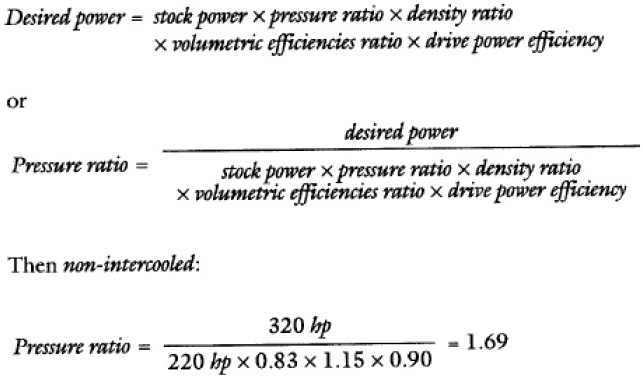
Desired Power = stock power x pressure ratio x density
ratio x volumetric efficiencies ratio x drive power efficiency
Volumetric Efficiencies = supercharger volumetric
efficiencies / engine volumetric efficiencies
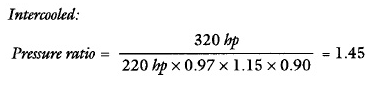
Pressure Ratio = desired power / existing power or
desired power / stock power x pressure ratio x density ratio x volumetric
efficiencies ratio x drive power efficiency
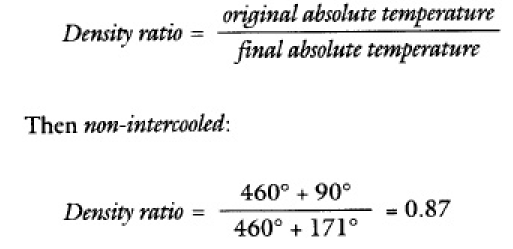
Density Ratio = original absolute temperature / find
absolute temperature
Root:
Non-Intercooled = 460degrees + 90 degrees / 460 degrees + 200 = .83
Intercooled = 460degrees + 90 degrees / 460 degrees + 107 = .97
Centrifugal:
Non-Intercooled = 460degrees + 90 degrees / 460 degrees + 170 = .87
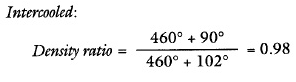
Intercooled = 460degrees + 90 degrees / 460 degrees + 102 = .98
| Density Ratio | Non-Intercooled | Intercooled |
| Root Supercharger | .83 | .97 |
| Centrifugal | .87 | .98 |
Lets plug in some numbers and make it real. Now we will be
using our first generation 1UZFE. A car is rated at 220 bhp and our
desired bhp will be 300. Lets use these formulas and see how it will
affect the outcome between intercooling and non-intercooling. The below
table show amount of boost require to achieve 300 bhp
| Type | Non-Intercooled | Intercooled |
| Root | 10.1 psi | 6.3 psi |
| Centrifugal | 7.2 psi | 4.7 psi |
What the above table saying is that for a 220 bhp to make 300
bhp. It would take a 10.1 psi in a non-intercooled root style supercharger
system to make 300 bhp in the same intake/chamber temperature as a 4.7 psi
intercooled Centrifugal supercharger system. In another word, it will take
a 10.1 psi from a root style supercharger to make the same power as a
intercooled 4.7 psi from a Centrifugal Supercharger system.
Here is an database that I have complied using 250 bhp as our
stock horsepower and comparing Root supercharger and Centrifugal along with
intercooling. The boost require for a intercooler Centrifugal system to
make 400 bhp would be around 6.6 psi vs. non-intercooled Root Style 12.52 psi.
The below data is calculated using Corky Bell’s book and formulas.
| 250 bhp base hp | Root Style Supercharger | Centrifugal Supercharger | ||
| Desired bhp | Boost Non-Intercooled | Boost Intercooled | Boost Non-Intercooled | Boost Intercooled |
| 300 bhp | 5.7575 psi | 2.793 psi | 3.3222 psi | 1.29999891 psi |
| 325 bhp | 7.448 psi | 4.263 psi | 4.82454 psi | 2.63333301 psi |
| 350 bhp | 9.1385 psi | 5.8065 psi | 6.326733 psi | 3.966648 psi |
| 375 bhp | 10.829 psi | 7.301 psi | 7.829024 psi | 5.30000121 psi |
| 400 bhp | 12.5195 psi | 8.80775 psi | 9.3312905 psi | 6.63333531 psi |
| 425 bhp | 14.21 psi | 10.3145 psi | 10.833557 psi | 7.96666941 psi |
| 450 bhp | 15.9005 psi | 11.82125 psi | 12.3358235 psi | 9.30000351 psi |
| 475 bhp | 17.591 psi | 13.328 psi | 13.83809 psi | 10.63333761 psi |
| 500 bhp | 19.2815 psi | 14.83475 psi | 15.3403565 psi | 11.96667171 psi |
| 525 bhp | 20.972 psi | 16.3415 psi | 16.842623 psi | 13.30000581 psi |
| 550 bhp | 22.6625 psi | 17.84825 psi | 18.3448895 psi | 14.63333991 psi |
| 575 bhp | 24.353 psi | 19.355 psi | 19.847156 psi | 15.96667401 psi |
| 600 bhp | 26.0435 psi | 20.86175 psi | 21.3494225 psi | 17.30000811 psi |
| 625 bhp | 27.734 psi | 22.3685 psi | 22.851689 psi | 18.63334221 psi |
| 650 bhp | 29.4245 psi | 23.87525 psi | 24.3539555 psi | 19.96667631 psi |
| 675 bhp | 31.115 psi | 25.382 psi | 25.856222 psi | 21.30001041 psi |
| 700 bhp | 32.8055 psi | 26.88875 psi | 27.3584885 psi | 22.63334451 psi |
| 725 bhp | 34.496 psi | 28.3955 psi | 28.860755 psi | 23.96667861 psi |
| 750 bhp | 36.1865 psi | 29.90225 psi | 30.3630215 psi | 25.30001271 psi |
| 775 bhp | 37.877 psi | 31.409 psi | 31.865288 psi | 26.63334681 psi |
| 800 bhp | 39.5675 psi | 32.91575 psi | 33.3675545 psi | 27.96668091 psi |
Full data from Excel Spread Sheet Boost
Calculation and Pressure Ratio
Pressure Ratio = desired power / existing power
PR = 400 / 250 = 1.6 The pressure ratio can tell us the boost pressure
needed, as pressure ratio of 1.60 mean that the boost pressure is .60 of an
atmosphere above atmospheric pressure of 14.7 psi.
Boost = .60 x 14.7 psi = 8.82 psi that would be intercooled root style
supercharger.
Density Ratio = original absolute temperature / find
absolute temperature
In order to begin our density ratio, we need to know about each type of
supercharger and its thermal efficiency. Here are the comparison of three
popular type of superchargers:
| Type | Et (%) | Temp increase with 1 psi |
| Roots | 55 | 18.5 |
| Screw | 70 | 14.6 |
| Centrifugal | 75 | 13.6 |
| Turbocharger | 75 | ??? |
Here is what Corky have to say about intercooling: “The
intercooler can rescue this bad temperature situation. Let’s look at the
whole picture again when we place an intercooler between the supercharger and
the engine. Assume the intercooler will remove 85% of the temperature put
in by the supercharger.
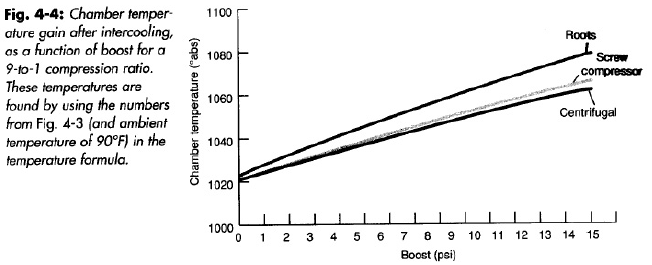
To calculate the final intercooled chamber temperatures, we
use the same procedure as in the previous section, inserting the intercooled
temperature gains from in the temperature formula for a 9:1 compression ratio.
This shows that with intercooling, we can run substantially higher boost before
reaching the arbitrary 1075 degrees limit: about 10 psi for roots and 13 psi for
centrifugal and twin screw.
Although this exercise in numbers is full of approximation,
its easy to show, for example, that you can run 40 psi boost intercooled at the
same chamber temperature as 8 psi non-intercooled”.
Here is an extreme comparison between low thermal efficient and
high thermal efficient supercharger. Secondly, we also compare a
non-intercooled root style supercharger with intercooled centrifugal
supercharger.
Non-intercooled root style supercharger Vs. a intercooled
centrifugal supercharger
| Type of Supercharger | Non-Intercooled @ 10 psi | Intercooled @ 10 psi |
| Root | 130 Degrees F | 17 Degrees F |
| Centrifugal | 90 Degrees F | 13 Degrees F |
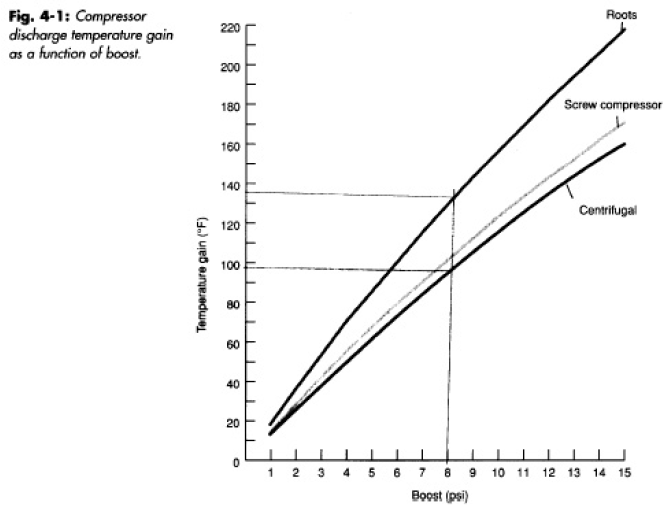
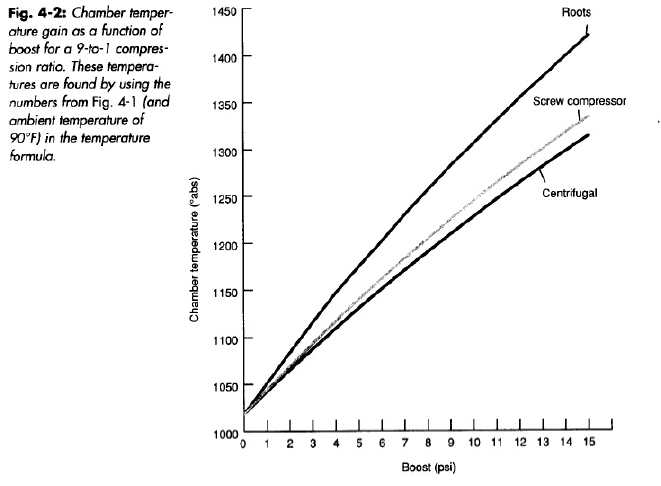
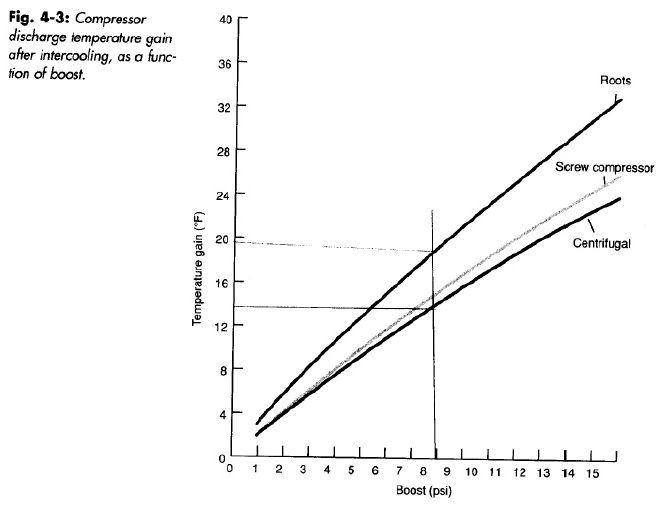
Below are the comparison between intercooled Centrifugal and Root Style
Supercharger and along with non-intercooled.
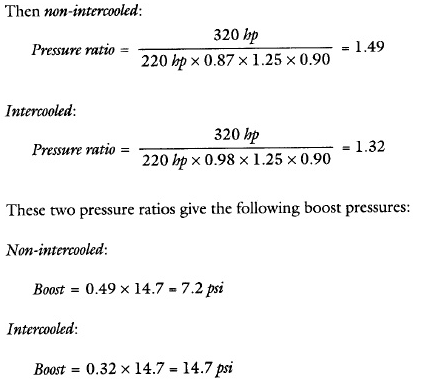
If you compare a non-intercooler root style at 10 psi vs. a intercooler
centrifugal at 10 psi is 130 degrees F to 13 degrees F. Its also 100
degrees difference at 10 psi. The above data is from Supercharged! book
page 40 and 42 ISBN 0-8376-0168-1