
This is little out of the left field as compared to previous articles. However, I feel this article will provides great information help you to become a better drag driver. The goal of the drag race is to get to the finished line in the shortest time.
However, human factor plays a major part in the area of reaction time and movement. As my background is in human performance and human development as well as neurological functions. I would like to share my experience and my expertise to help you shave off few milliseconds in your Drag Race ET
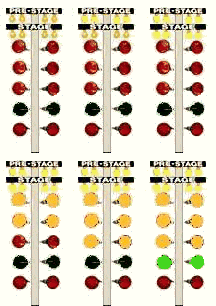
You can test your reaction time by using this Virtual Sportsman Tree
As a major misconception of reaction time and we hear it all the time. Especially police officers give you a tailgating ticket for following the car of you too close. They usually state “You are following the car in front of you and you do not have enough time to react”. The question is how does he know what is your reaction time? Let explore some human cognitive development and research in this area.
Type of Reaction Time.
There are few types of Reaction Time
Simple: reaction time experiments, there is only one stimulus and one response. ‘X at a known location,’ ‘spot the dot,’ and ‘reaction to sound’ all measure simple reaction time. This category of RT is shortest
Recognition: reaction time experiments, there are some stimuli that should be responded to (the ‘memory set’), and others that should get no response (the ‘distracter set’). There is still only one correct response. ‘Symbol recognition’ and ‘tone recognition’ are both recognition experiments. In drag race, this recognition reaction time is more applicable. However, if going to the drag stripe as your first time, this would be Choice reaction time.
Choice: reaction time experiments, the user must give a response that corresponds to the stimulus, such as pressing a key corresponding to a letter if the letter appears on the screen. The Reaction Time program does not use this type of experiment because the response is always pressing the spacebar. This RT is longer
Reaction & Movement Times
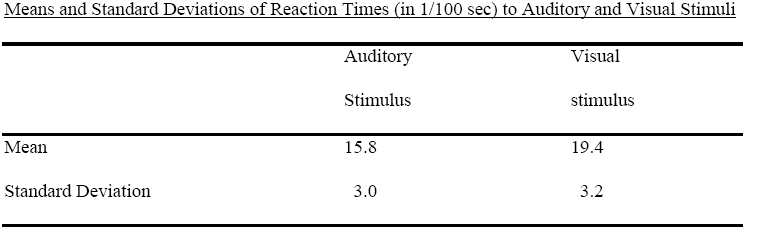
A simple reaction times for college-age individuals have been about 190 ms (0.19 sec) for light stimuli and about 160 ms for sound stimuli. Now, why is light stimuli is about190 ms and 160 for sound stimuli? We will explore this issue later. However, what is the definition of RT? As I stated earlier that the police officer gave you a ticket for tailgate. The true definition of reaction time is: The time begins with the initiation of the stimuli and the initiation of the movement.
What does this mean? It means when you send the red light and you let the gas pedal off, the that is reaction. This reaction process is in the brain and there is no way that the police officer can measure that objectively. Movement time however is the initiation of the movement to the end of movement. Back to the red light example, as you take your right foot off the gas pedal and start pressing on the brake pedal until the car completely stop, is define as movement time. By definition, the police officer would not have a case because his have the wrong definition. What he is giving a ticket should be movement time, not reaction time. If you get this type of ticket. Fight it!
There are many factors that affect you reaction time.
Type of Stimulus
Many researchers have confirmed that reaction to sound is faster than reaction to light, with mean auditory reaction times being 140-160 msec and visual reaction times being 180-200 msec. Perhaps this is because an auditory stimulus only takes 8-10 msec to reach the brain , but a visual stimulus takes 20-40 msec . Reaction time to touch is intermediate, at 155 msec. Differences in reaction time between these types of stimuli persist whether the subject is asked to make a simple response or a complex response.
What I learned about RT & MT few years ago was that its two physiological process for the auditory (sound) vs. visual stimuli takes three physiological process. Therefore, the first thing is to somehow if we can cover the lights to sound, we would cut about 40 msec off the RT. I wonder if this would be illegal in the NHRA regulation?
Stimulus Intensity
Many researchers found that visual stimuli that are longer in duration elicit faster reaction times, and auditory stimuli is shorter. Researchers reported that the weaker the stimulus (such as a very faint light) is, the longer the reaction time is. However, after the stimulus gets to a certain strength, reaction time becomes constant. In other words, the relationship is:
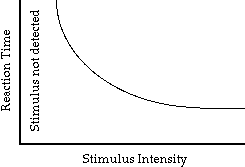
Many human developmentists found that the difference between reaction time to light and sound could be eliminated if a sufficiently high stimulus intensity was used.
Other Factors Influencing Reaction Time
If variation caused by the type of reaction time experiment, type of stimulus, and stimulus intensity are ignored, there are still many factors affecting reaction time.
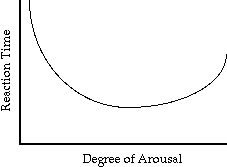
Arousal. One of the most investigated factors affecting reaction time is ‘arousal’ or state of attention, including muscular tension. Reaction time is fastest with an intermediate level of arousal, and deteriorates when the subject is either too relaxed or too tense. That is, reaction time responds to arousal as follows:
Subjects who had to react to an auditory stimulus by extending their leg had faster reaction times if they performed a 3 second isometric contraction of the leg muscles prior to the stimulus.
You might expect that the muscle contraction itself would be faster (because the muscle was warmed up, etc.), but what was surprising was that the precontraction part of the reaction time was shorter too. It was as if the isometric contraction allowed the brain to work faster. Its a bell shaped curve. Too much or not enough arousal will have negative effect on RT.
Age. Reaction time shortens from infancy into the late 20s, then increases slowly until the 50s and 60s, and then lengthens faster as the person gets into his 70s and beyond. Researchers also reported that this age effect was more marked for complex reaction time tasks. Reaction time also becomes more variable with age and they speculates on the reason for slowing reaction time with age. It is not just simple mechanical factors like the speed of nervous conduction.
It may be the tendency of older people to be more careful and monitor their responses more thoroughly. When troubled by a distraction, older people also tend to devote their exclusive attention to one stimulus, and ignore another stimulus, more completely than younger people. An early study reported that for teenagers (15-19) mean reaction times were 187 msec for light stimuli and 158 ms for sound stimuli.
Gender. At the risk of being politically incorrect, in almost every age group, males have faster reaction times than females, and female disadvantage is not reduced by practice reported that mean time to press a key in response to a light was 220 msec for males and 260 msec for females; for sound the difference was 190 msec (males) to 200 msec (females). In comparison many researchers reported a reaction time to sound of 227 msec (male) to 242 msec (female).
They also found that almost all of the male-female difference was accounted for by the lag between the presentation of the stimulus and the beginning of muscle contraction. Muscle contraction times were the same for males and females. Subjects reported that males use a more complex strategy than females. I wonder why there are more male race than female. The female are physiologically challenged.
Direct vs. Peripheral Vision. Recently we also noticed that visual stimuli perceived by different portions of the eye produce different reaction times. The fastest reaction time comes when a stimulus is seen by the cones (when the person is looking right at the stimulus). If the stimulus is picked up by rods (around the edge of the eye), the reaction is slower. Practice on a visual stimulus in central vision shortened the reaction time to a stimulus in peripheral vision, and vice versa. Therefore, look straight at the lights tree to maximum stimulation.
Practice and Errors. We also know that when subjects are new to a reaction time task, their reaction times are less consistent than when they’ve had an adequate amount of practice. Also, if a subject makes an error (like pressing the spacebar before the stimulus is presented), subsequent reaction times are slower, as if the subject is being more cautious. Lab experiments found that reaction time to a visual stimulus decreased with three weeks of practice and that training older people to resist falls by stepping out to stabilize themselves did improve their reaction time.
Fatigue. We found that reaction time gets slower when the subject is fatigued and observed that this deterioration due to fatigue is more marked when the reaction time task is complicated than when it is simple. Mental fatigue, especially sleepiness, has the greatest effect. Its obvious, get a good night sleep and have a good hearty meal would help a lot.
Distraction. Many early research reviewed studies showing that distractions increase reaction time and found that college students given a simulated driving task had longer reaction times when given a simultaneous auditory task.
They drew conclusions about the safety effects of driving while using a cellular phone or voice-based e-mail. Subjects strapped to a platform that periodically changed orientation had slowed reaction time before and during platform movement. The reaction time to auditory stimuli was more affected than response to visual stimuli. Basically, you need to be focus on the run.
Warnings of Impending Stimuli. Reaction times are faster when the subject has been warned that a stimulus will arrive soon. In the Reaction Time program, the delay is never more than about 3 sec, but these authors report that even giving 5 minutes of warning helps. Warning was longer than about 0.2 sec., the shorter the warning was, the faster reaction time was. This effect probably occurs because attention and muscular tension cannot be maintained at a high level for more than a few seconds. That is why there are few sets of yellow lights to warn you about the green light. I normally leave at the second yellow.
Warnings about Impairment by Alcohol. Ah, the A word. Subjects who had drunk an impairing dose of alcohol reacted faster when they were warned that this was enough alcohol to slow their reaction time. Unwarned subjects who drank suffered more decreased reaction times.
However, the warned subjects were also less inhibited and careful in their responses. Even subjects who drank some nonalcoholic beverage and then were warned (falsely) about impairment by alcohol reacted faster than unwarned subjects who drank the same beverage. Don’t drink before the drag race. Its clearly state that this will affect your reaction time.
Breathing Cycle. Reaction time was faster when the stimulus occurred during expiration than during inspiration.
Personality Type. Extroverted personality types had faster reaction times, and anxious personality types had faster reaction times.
Exercise. Exercise can affect reaction time. Physically fit subjects had faster reaction times, and subjects had the fastest reaction times when they were exercising sufficiently to produce a heart rate of 115 beats per minute.
Stimulant Drugs. Administering an amphetamine-like drug to a group of elderly men did not make their reaction times faster, although it did make their physical responses more vigorous.
Conclusion:
The above factors that affect reaction time, However, I still if we can build an device that will convert the second yellow light into a sound, then our reaction time will be much shorter. The delay reaction from visual stimulation is due to physiologic and therefore sound trigger would be much better. Would that considered cheating? If we can convert the light to sound, we can cut at least 5 msec.
Now you know the techniques to improve your reaction time, you also need to practice your movement time. Since drag race involved in a complex movements. The more you practice both of the components the lower your Elapse Time (ET) will be. However, the factors that influence RT plays a major role. Remember, you ear will work better than your eyes.
Thanks, Article partially adapted from Robert J. Kosinski.